That helmet hanging in your barn — the one you've had for a few years, maybe longer — looks just fine. No visible cracks, straps still intact, fits the same as always. But here's what nobody tells you when you first start riding: the damage that matters most is invisible. As experienced equestrian suppliers, we know that the protective foam inside your helmet starts breaking down long before any outward signs appear. It loses its ability to absorb impact — the kind of impact that could one day save your life. So how often should you get a new equestrian helmet? The answer is more specific — and more urgent — than most riders expect.
Whether you are a casual rider or sourcing gear from top equestrian clothing manufacturers, understanding the lifespan of safety equipment is critical. Everything you need to know is right here.
Most manufacturers put the standard replacement window at 3 to 5 years. But the range is wider than you'd think. Major brands like Charles Owen, OneK, and M&M Tack recommend replacing from first wear. KASK stretches their guideline to 10 years from the manufacturing date. However, leading equestrian manufacturers know that usage dictates reality. Casual riders — once or twice a week — can feel confident at the 5-year mark. Professionals riding five or six horses a day should aim closer to 2–3 years.
There is a stark reality in the industry: 78% of equestrians say they would not replace their helmet after a fall. This contradicts every major safety guideline provided by reputable equestrian outfit manufacturers. The rule is simple and firm: any fall where your helmet hits the ground, a jump, or a rail means immediate replacement.
No exceptions. The same goes for a helmet dropped hard on concrete. A hard impact — even one you can't see — can crack the foam liner inside. Whether you are buying a custom equestrian helmet or a standard model, that liner is what absorbs the force. Once it's compromised, the helmet won't protect you the same way again. Your replacement clock starts at first use. Not the purchase date. Not the manufacturing stamp inside the shell. The moment you put it on and ride, the countdown begins.
The Lifespan Reality: Brand Guidelines and Manufacturing Dates
Here's the honest answer: it depends on whose label is stitched inside your helmet. Guidelines vary across the industry, something that every equestrian clothing manufacturer acknowledges when designing safety gear.
Charles Owen and Back on Track hold firm at 5 years from first wear — full stop, regardless of how pristine the helmet looks. uvex allows up to 5 years of active use, but draws a hard line at 8 years total age. KASK sits at the far end, recommending up to 10 years from the manufacturing date. This accounts for factors like temperature fluctuation, UV exposure, and intensity of use — variables that any equestrian clothing factory tests for rigorously.
A helmet that spent two years on a shop shelf before you bought it has already aged. Foam becomes more brittle over time. Resins and adhesives used by equestrian manufacturers break down. The clock doesn't pause just because the helmet hasn't touched your head yet. That's why smart buyers check the stamped date inside the shell, not just their receipt.
Usage frequency shifts the timeline significantly. For competitive or professional riders hitting the saddle multiple times a day, the recommended replacement window shrinks to 2–3 years. Regular recreational riders who ride a few times a week can generally treat the 5-year mark as a safe ceiling. Meanwhile, occasional riders might safely stay within the longer end of the 3–5 year window, as some brands acknowledge that lower hours of use produce less wear and tear.
This is why finding a reliable equestrian clothing manufacturer or supplier who understands these nuances is key. The phrase "from first wear" carries a lot of weight. It means the moment you clip the harness. Not the day you ordered it from a distributor of wholesale equestrian clothing. That's when your timeline begins.
Why Riding Frequency Changes Everything
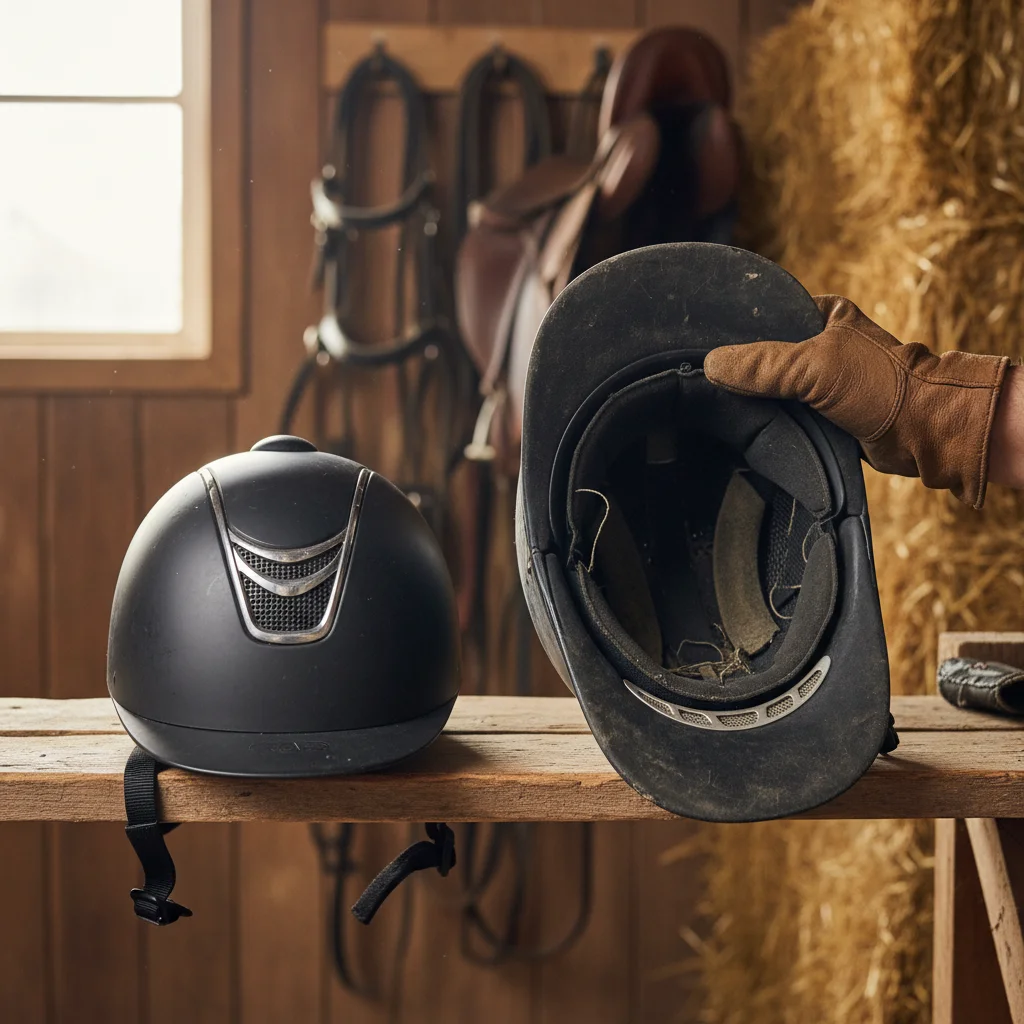
Two riders buy the same helmet on the same day. Five years later, one helmet still does its job. The other gave out years ago. The difference isn't luck. It's mileage. Riding frequency is one of the most overlooked factors in how long a riding helmet lasts, yet it is a primary consideration for equestrian outfit manufacturers designing gear for longevity.
Here's how the numbers break down:
Rider Type | Annual Mileage | EPS Degradation Rate | Recommended Replacement |
|---|---|---|---|
Casual (1–2 rides/week) | 6,000–8,000 miles | ~3–5% shrinkage per year | 5 years / 40,000–50,000 miles |
Moderate recreational rider | 8,000–20,000 miles | Moderate acceleration | 3–4 years |
Professional / daily rider | 20,000+ miles | 2–3x faster liner erosion | 2–3 years |
That 2–3x faster degradation for high-use helmets is not a rough guess. It's what cumulative wear does to EPS foam. At 20,000 miles a year, critical foam shrinkage can hit in just 2–3 years. The same foam in a lightly used helmet from a top equestrian clothing factory may hold until year five.
Mileage isn't the only factor; environmental stressors speed up that timeline significantly. Sweat and skin oils rapidly break down the inner liner—a common issue for shared helmets from schools or wholesale riding helmet fleets. Furthermore, direct UV exposure and sunlight wear down the outer shell material over time, whilst temperature swings and moisture cause the EPS to harden and shrink faster than gear kept in climate-controlled storage.
If you are unsure where you stand, go with the professional standard. Whether you wear standard gear or premium custom equestrian apparel, aim for 2–3 years if you ride frequently. A helmet that still looks fine may already be failing where it matters most.
The Science of Invisible Damage: Why Tech Matters
EPS foam — the dense, white material packed inside your helmet's shell — gives no warning when it starts failing. This is a challenge that OEM/ODM services in the safety gear sector work constantly to address. No color change. No creak. No give. It absorbs impact after impact, year after year, and loses its ability to protect you without a single visible sign.
Research tracks this decline. A study tracked 675 bicycle helmets manufactured between 1987 and 2013. Impact readings increased by 0.7g per year. Environmental factors speed this up. Humidity works into the foam's structure. Major equestrian suppliers analyze this degradation to set warranty limits. The foam stiffens. Its energy-absorbing capacity shifts. The gap between "protected" and "not protected" gets smaller, ride by ride.
Passing a structural test is not the same as performing at full protection. A helmet can hold its shape, look intact, and still leave you exposed. This is why riding helmet foam degradation is so easy to miss. Top-tier equestrian clothing manufacturers emphasize that the damage builds inside the foam — in the compressed cells that break down one ride at a time.
When to Replace Immediately: The "One Hit" Rule
Some things in equestrian life are hard to judge. Replacing your helmet is not one of them. The signs are clear, particularly for those familiar with the standards set by equestrian manufacturers.
Visible damage to the outer shell — cracks, fractures, even hairline splits — means the structural integrity is gone. A cracked shell can't redirect force the way it should. This applies whether you are wearing a basic schooling helmet or a high-end custom equestrian helmet. If the inner EPS liner looks crushed, flattened, or deformed in any spot, that foam has already done its job. EPS absorbs a major impact by compressing — and that compression is permanent.
Any fall, drop, or collision — replace the helmet. No debate. EPS damage from an impact is microscopic. You can't see it. The foam compresses at a cellular level. The helmet can look fine and still give you almost no protection on the next hit. wholesale equestrian clothing distributors often include replacement warnings on tags for this exact reason.
There are two less obvious triggers worth knowing. First, any change in head size or hairstyle that alters the fit means the helmet no longer protects you correctly—fit is not adjustable when it comes to safety, even with custom equestrian clothing. Second, a missing, damaged, or outdated certification label is reason enough to replace it immediately; no label simply means no verified protection.
Check your chin straps with a simple pull test. The retention system must hold up to 30G of force. Frayed webbing or cracked buckles are disqualifying. These components, often sourced from specialized equestrian outfit manufacturers, are designed to save lives, but only if they are intact.
Certifications and Safety Standards: What You Need to Know

Certification standards change — and your helmet needs to keep up. The label inside your helmet shell isn't just a formality; it is the guarantee provided by the equestrian clothing factory. It shows which safety standard the helmet met at the time it was made.
The three standards that matter most:
ASTM F1163 (American) — Versions F1163-15 or F1163-23 are the only valid ones.
PAS 015:2011 (British) — The toughest standard in equestrian use, requiring penetration and crush resistance tests.
VG1 01.040 (European) — Essential for brands offering private label equestrian clothing and gear in Europe.
The FEI is also tightening the rules. From January 2026, your helmet must meet at least one FEI-accepted standard, such as PAS 015:2011 or ASTM F1163:23. By January 2028, requirements stiffen further, demanding helmets meet at least two accepted standards—a shift that will impact everyone from individual riders to wholesale riding helmet buyers.
Flip the helmet over and look inside the shell. A valid label shows the standard name, the quality mark, a manufacturing date, and the model. A label that doesn't match an accepted standard means the helmet isn't protecting you the way it should — no matter how good it looks on the outside.
Navigating Brand Timelines and New Technology

Understanding when to replace your helmet also involves knowing your brand. Charles Owen draws a firm line at 5 years from first wear. KASK splits its answer: 3 years for general helmets, but up to 10 years for their equestrian line from the manufacturing date. OneK sticks with the conservative industry standard of 5 years. These policies are set by the equestrian clothing manufacturer based on their specific materials and testing.
Technology has moved fast. If your helmet predates 2021, it is likely outdated compared to what innovative equestrian suppliers are producing today.
Key innovations include:
MIPS (Multi-directional Impact Protection System) is now standard across most helmets from top equestrian manufacturers. It redirects rotational force away from the brain.
Carbon fiber and composite shells have cut weight by up to 30%, a feature often highlighted in custom equestrian apparel lines for eventers.
Ventilation systems now push significantly more airflow, a critical comfort factor designed by OEM/ODM services engineers.
When choosing your next helmet, start with certification. Then check the fit. After that, look for MIPS technology. Whether you buy off the shelf or order a custom equestrian helmet, these priorities remain the same.
Conclusion
Your helmet has one job: to work in the background until the moment it matters most. By then, it's too late to ask whether the foam inside had already broken down. As industry-leading equestrian suppliers, we emphasize that safety is not an area for compromise.
Remember the core rules: Replace your riding helmet every three to five years, and replace it right after any impact. Whether you are a casual rider, a professional, or a retailer sourcing wholesale riding helmet stock, these guidelines are non-negotiable. The damage that kills is the damage you can't see.
If you are looking for the latest in safety technology, now is the time to upgrade. From custom equestrian clothing to certified protective gear, the options have never been better. Reach out to trusted equestrian clothing manufacturers or private label equestrian clothing specialists who can provide gear built to today's rigorous standards. Your brain is irreplaceable. Your helmet is not.
For businesses looking to expand their safety lines, consider partnering with an experienced equestrian clothing factory that offers OEM/ODM services and wholesale equestrian clothing. Ensuring your customers have access to fresh, safe, and certified helmets is the ultimate responsibility of all equestrian outfit manufacturers.