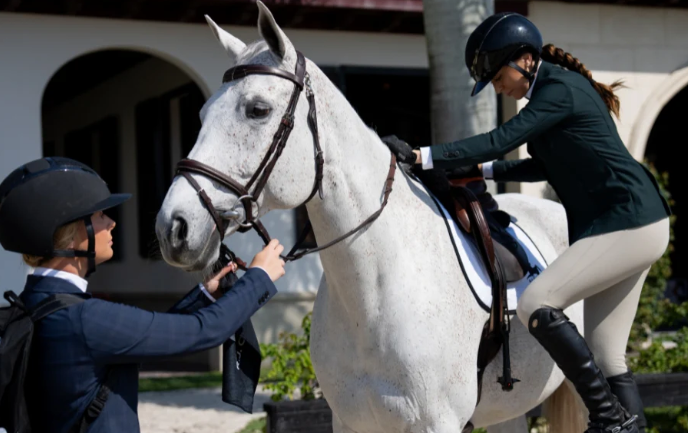
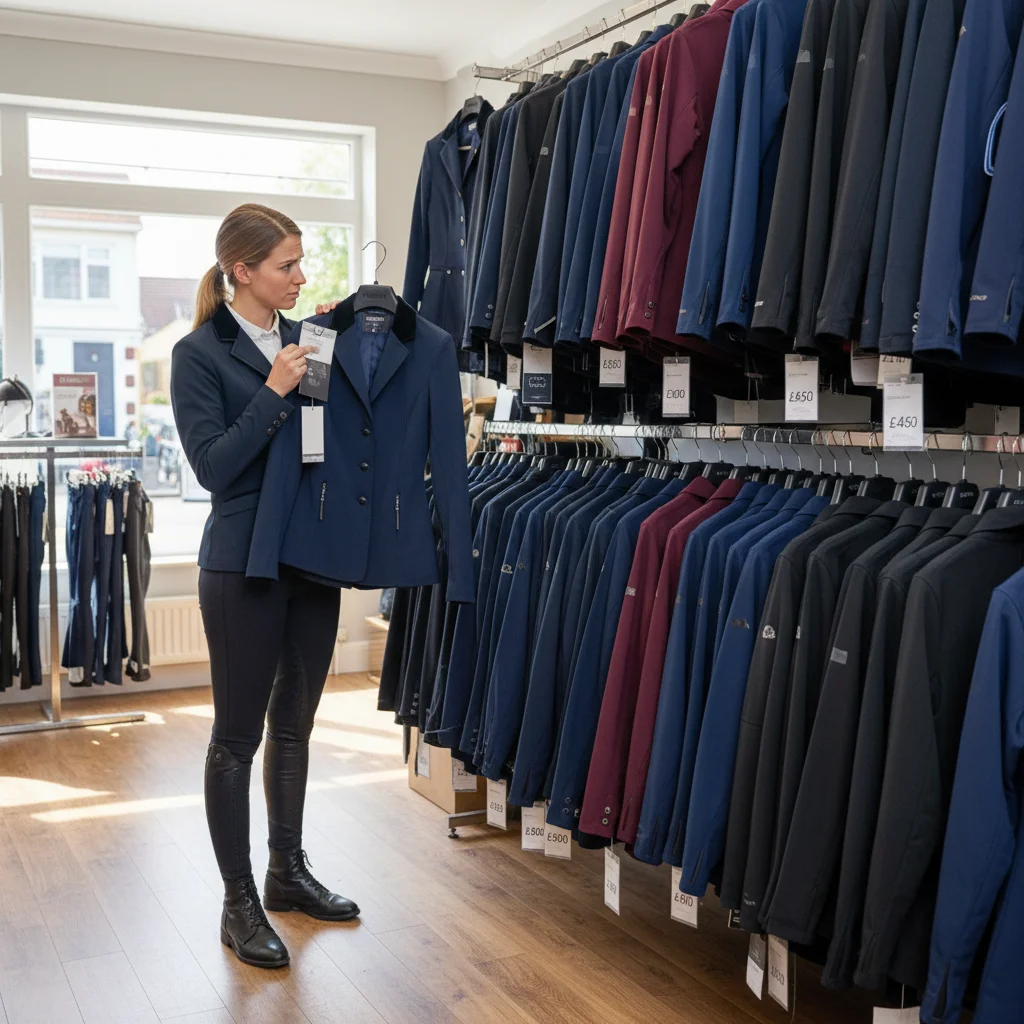
You stand in front of a rack of equestrian jackets, and that familiar wave of confusion hits—waterproof or breathable? Softshell or traditional show coat? It’s a common dilemma. Finding the right gear often means navigating a maze of options from various equestrian suppliers, each claiming their technology is superior.
Maybe you're preparing for your first dressage competition, upgrading your winter riding gear, or simply tired of getting soaked during morning training sessions. Choosing the best equestrian jacket goes beyond looking professional. It's about riding in comfort and performing with confidence, regardless of the weather. Many riders are turning to custom equestrian clothing to solve fit issues, while others rely on trusted off-the-rack brands.
The right jacket becomes your second skin in the saddle. It protects you from the elements while allowing complete freedom of movement. This guide cuts through the marketing jargon used by equestrian clothing manufacturers. You'll learn what features matter for your riding discipline, climate, and budget, helping you avoid expensive mistakes that leave many riders with closets full of jackets they never wear.
Decoding Equestrian Jackets: Show Coats vs. Technical Wear
Equestrian jackets generally fall into two main groups: competition show coats and everyday riding jackets. Understanding the distinction is vital before you start browsing catalogs from equestrian outfit manufacturers. Each has a specific job, and knowing the difference helps you avoid purchasing gear that doesn't serve your purpose.
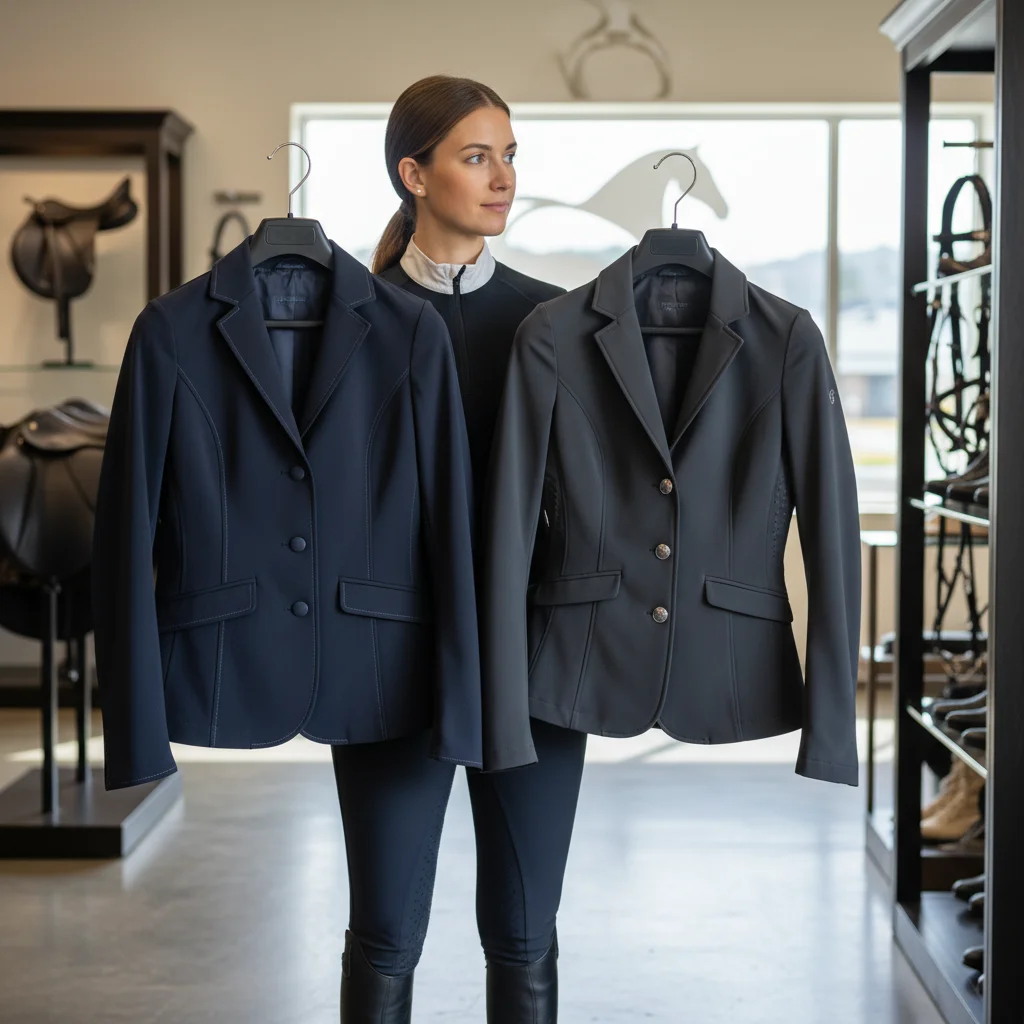
Hunter Jumper Show Coats are the standard for English riding competitions. Featuring a classic 3- or 4-button front with notch lapels, modern versions utilize light, breathable fabrics with stretch panels where needed. While navy and black remain staples, new tech fabrics from Leading equestrian clothing manufacturers keep the traditional look but add moisture-wicking power. For Dressage, requirements are stricter. Lower levels stick to standard coats, but moving up to Fourth Level usually requires a shadbelly—a double-breasted style with weighted tails. Meanwhile, Jumper Coats allow for more personality with shorter cuts, bright colors like blue or burgundy, and details like crystal buttons that catch arena lights.
On the flip side, we have technical wear designed for the daily grind. Softshell Riding Jackets have revolutionized training. These water-resistant layers use four-way stretch fabric that moves with you, packing small enough to go from stable to saddle without fuss. For those braving the elements, Winter Riding Jackets provide necessary warmth without the bulk, often featuring removable liners and longer back panels to cover your lower back while mounted. Whether you are looking for wholesale equestrian clothing for a riding school or a single personalized piece, understanding these categories is your first step.
The Science of Materials and Technical Features

When you strip away the branding, technical specs are what keep you dry. You need to verify the claims made by your equestrian clothing manufacturer to ensure the gear can handle your reality.
Let's talk about moisture protection. Waterproof riding jackets utilize special membranes—think Gore-Tex or high-quality PU coatings—that block moisture entirely. You should look for ratings above 10,000mm hydrostatic head if you ride in sustained rain.
This is a standard often found in high-end custom equestrian jackets designed for professional use. In contrast, water-resistant softshells handle light rain and dew using DWR (Durable Water Repellent) treatments. While they breathe better, the coating wears off after 20-30 washes, requiring re-treatment.
Breathability is just as critical. The MVTR (Moisture Vapor Transmission Rate) measures how much water vapor passes through the fabric. Ratings above 10,000g/m²/24hr are ideal for hard riding. To achieve this, many manufacturers mix stretch polyester with 15-20% elastane (spandex) and incorporate mesh panels. For winter insulation, synthetic fills like PrimaLoft retain warmth even when wet, whereas down offers superior warmth-to-weight ratios but clumps if moisture gets in. Hybrid designs are often the best compromise, placing synthetic fill in high-sweat areas.
Matching Your Gear to Riding Seasons

Season-matching isn't about looking at a calendar; it's about understanding how wind and activity change your thermal needs. A 50°F morning feels mild in the barn, but at a canter, the effective temperature drops significantly.
Spring and Fall are the layering sweet spots. Temperatures between 50–65°F require versatility. A softshell riding jacket over a base layer usually suffices. However, if you are sourcing custom equestrian clothing, consider adding a vest layer. When wind chill kicks in, that vest blocks the breeze while letting moisture escape. Above 65°F, it's best to strip down to a technical shirt with sun protection.
Winter demands a smarter approach than just "thicker is better." Below 50°F, start with a wicking base layer, add a micro-fleece mid-layer, and top with an insulated jacket. Synthetic insulation is generally preferred by equestrian suppliers for active winter riding because it handles sweat better than down. Look for jackets with removable liners to adapt to fluctuating temperatures. Conversely, Summer riding above 75°F is about survival and airflow. Modern outerwear uses mesh panels and cooling fabrics that offer abrasion resistance without the heat trap, a potentially life-saving feature innovation from top equestrian outfit manufacturers.
Need Custom Equestrian Jackets?
From softshell training jackets to competition show coats — we manufacture to your exact specs. MOQ 300 pcs.
Get Free SampleFit, Sizing, and Why Street Clothes Don't Work
A jacket that restricts your shoulder rotation destroys your balance. Fit dictates performance. The most common mistake is assuming your street size applies here. It rarely does. Arms extend forward to hold reins, shoulders roll back, and the torso angles differently than when walking.
European brands tend to run smaller than American cuts, and variations exist even between reputable equestrian clothing manufacturers. A UK 10 might act like a US 6. When trying on a jacket, check three zones: Shoulders (seams should sit on your natural line, not your arm), Sleeves (cuffs must reach your wrist bone while arms are extended in riding position), and Torso Length (it must cover your belt line while mounted).
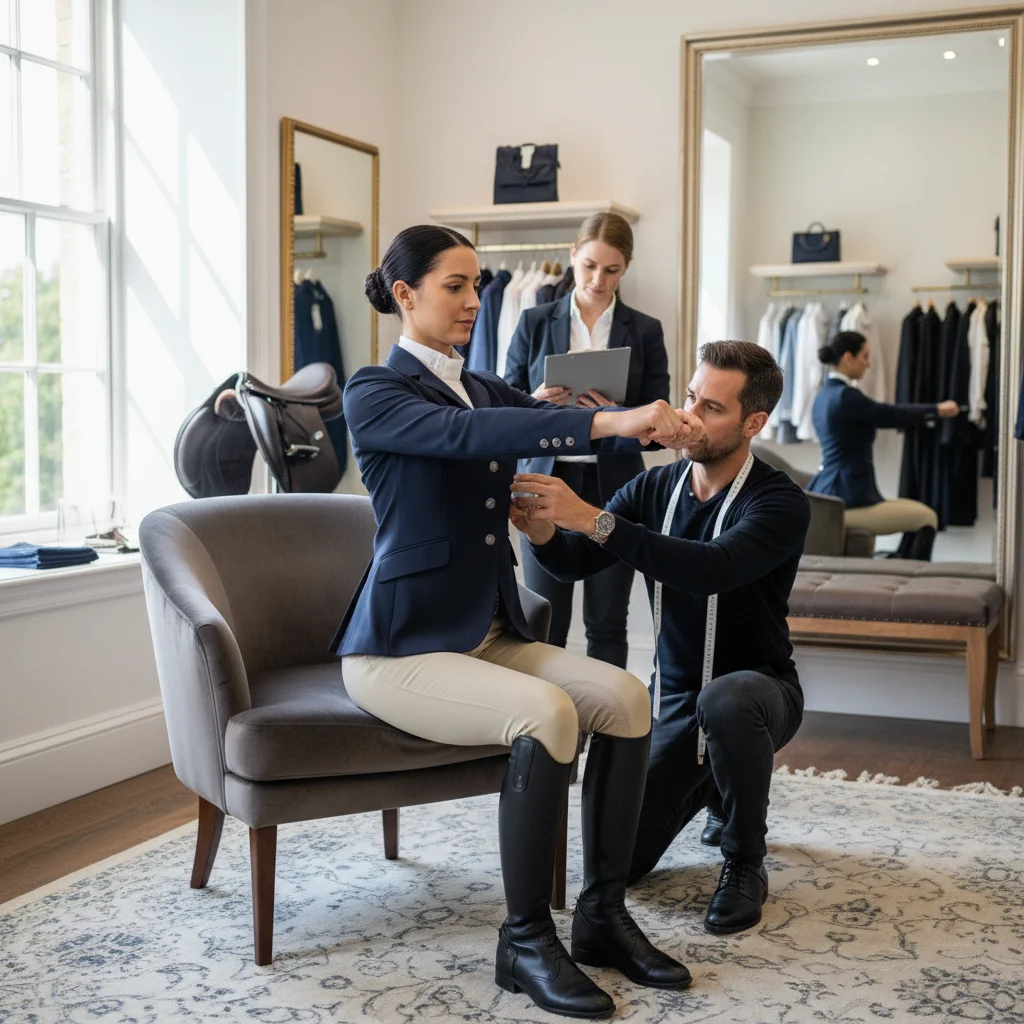
Pro fit studies suggest you need about 8mm of extra space across the chest and 5mm at the sides. This is why many riders eventually turn to a custom equestrian outfit to get that precise tailoring without the restriction. If you can't go custom, always test the jacket by sitting in a chair and extending your arms as if holding reins. If it pulls across the back, size up.
Selection Criteria: From Beginner to Pro
Your riding intensity dictates your gear. Beginners might chase style, but experts require performance metrics that keep them safe. Retailers often stock different tiers, from wholesale equestrian clothing for schools to elite gear for professionals.
Beginner and Recreational Riders should focus on foundations. Class A or AA technical jackets offer abrasion resistance suitable for low speeds. For shows, a single, machine-washable coat like the R.J. Classics Sydney II is a smart start. There is no need to overspend on a custom equestrian outfit just yet; a versatile softshell ($200-$400) serves training needs better than a specialized $600 piece you might outgrow.
Intermediate and Competitive Riders face longer sessions and higher speeds. Class AA garments become the baseline. If you are ordering from equestrian suppliers with a focus on jumping or cross-country, verify that the gear accommodates Level 1 or 2 CE armor. You will likely need multiple coats now: a durable one for schooling and a pristine one for rated shows.
Expert and Professional Riders prioritize precision. At this level, high-end custom equestrian jackets or top-tier technical wear (Class AAA abrasion ratings) are essential. Zone-specific construction ensures safety without compromising mobility. Professionals view these jackets as tools to protect their livelihood, meaning price is secondary to performance and durability.
Top Brands and Strategic Selection
The market is generally divided between heritage European makers and American technical innovators. Your choice depends on whether you value old-world tailoring or cutting-edge fabric tech.
American Technical Leaders: Ariat dominates with practical innovation, such as their EcoDry™ technology. Their Ideal Down Jacket is a staple for versatility. Kerrits offers excellent value, often using Merino wool blends that regulate temperature naturally. These brands are accessible and practical, often functioning as the primary equestrian clothing manufacturer for day-to-day barn life in the US.
European Heritage: Brands like Pikeur (Germany) and Samshield (France) represent the pinnacle of fit and luxury. Pikeur coats are engineered based on thousands of body scans, while Samshield integrates Swarovski details for the show ring. If you are looking for high-end custom equestrian jackets aesthetics off the rack, these are your go-to options. R.J. Classics bridges the gap, offering European styling with American practicality and machine-washable fabrics. Italian brands like Equiline and EGO7 bring luxury tailoring, often with a higher price tag but impeccable style.
Men have options too, with brands like Barbour providing classic wax jackets and Ariat offering specialized men's technical wear. Ultimately, match the brand's strength to your need: Kerrits for layering, Ariat for technical weather protection, and Pikeur or Samshield for the competitive edge.
Source Premium Riding Jackets Direct
Cut out the middleman. Work directly with our factory for competition-grade equestrian jackets at wholesale prices.
Request QuoteBudgeting and Avoiding Expensive Mistakes
- Basic safety & rule compliance
- Machine-washable fabrics
- Suitable for beginners & recreation
- Superior fabrics & longevity
- Zone-specific construction
- 6+ year lifespan, lower cost-per-wear
There is a massive difference between entry-level gear and professional equipment. Entry-level jackets ($129-$400) work well for safety and basic rule compliance. Professional-grade options ($400-$830+) offer longevity and superior fabrics. The real cost isn't the price tag; it's replacement frequency. A quality coat lasting six years is cheaper than replacing a budget coat three times.
However, spending money doesn't guarantee satisfaction if you fall into common traps. The sizing trap catches many who buy their street size only to find they can't move their shoulders. The weather rating confusion is another money pit—buying "water-resistant" when you actually need "waterproof" (10,000mm+) results in soaked rides. Furthermore, neglecting to check discipline rules can leave you with a beautiful but unusable coat. Always verify wholesale equestrian clothing return policies if buying in bulk or online to ensure sizing is correct.
Only buy during sales if the item fits your specific climate and discipline needs. Buying a 40% off heavy winter coat when you live in Florida is never a bargain.
Care, Maintenance, and Conclusion
Your investment largely depends on how you treat it. Regular laundry detergent can destroy the membranes in technical jackets. Use technical washes like Nikwax to clean without stripping DWR coatings, and never use fabric softeners. For structured show coats, especially those with crystal details, expensive dry cleaning or careful hand washing is necessary. Proper storage on padded hangers prevents shoulder dimples that can ruin the silhouette of even the most expensive high-end custom equestrian jackets.

Finding the perfect equestrian jacket is an investment in your safety and performance. whether you are sourcing from oversized equestrian suppliers or a boutique equestrian clothing manufacturer, the goal remains the same: comfort in the saddle.
The best jacket is the one you forget you're wearing because it fits so well. It protects you from the elements without causing you to overheat. Don't rush the decision. Whether you opt for off-the-rack technical wear, sturdy wholesale equestrian clothing for daily training, or a bespoke custom equestrian outfit for the show ring, ensure it aligns with your climate and riding goals. Your ideal jacket is out there—now you have the knowledge to find it.
Ready to Build Your Equestrian Brand?
15+ years manufacturing experience. Custom designs, private labeling, and OEM services for equestrian apparel brands worldwide.
Learn About Us