The wrong riding boot is more than a fashion mistake. It can affect your safety, your position in the saddle, and yes — your instructor will notice your footwear. Honestly, when you're spending time and money piecing together your gear from reliable equestrian suppliers, pairing the right footwear with top-tier custom equestrian clothing completes the whole package.
For riders caught between English and Western styles, the differences can feel hard to spot at first. Heel height, sole thickness, shaft construction — the details blur fast. Before you know it, you've ordered the wrong pair or picked whatever looked good in the photo. As many seasoned equestrian clothing manufacturers will tell you, understanding these gear nuances early on saves you from costly mistakes in the ring.
This guide cuts through that confusion. You'll find clear answers on:
Shopping for your first pair of tall riding boots
Comparing cowboy boots for riding against a paddock boot
Understanding why each discipline calls for different equestrian footwear
By the end, you'll know exactly what to look for — and what to skip.
What Makes English and Western Riding Boots Different
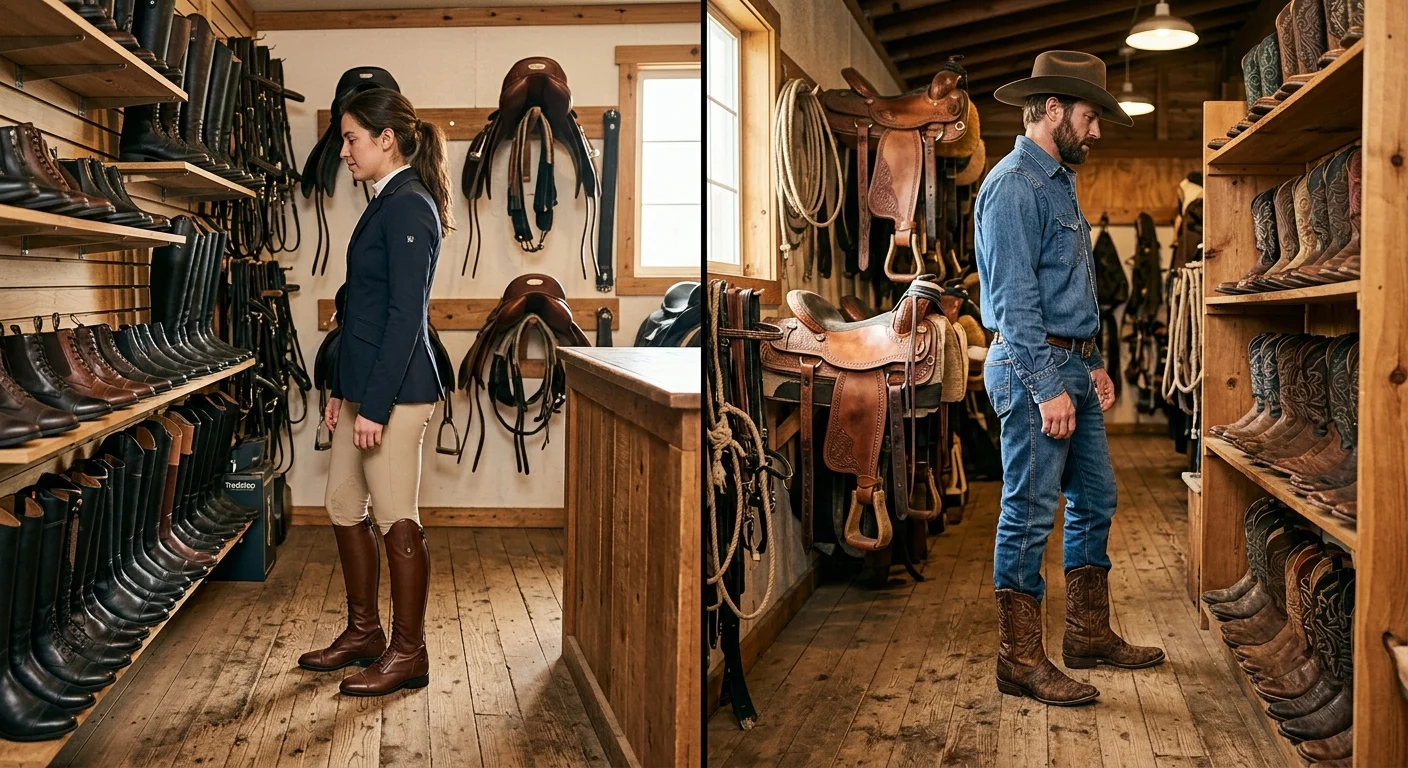
Two remarkably different worlds built these boots. English riding boots grew out of British equestrian tradition — a discipline built on absolute precision and the quiet conversation between leg and horse. Western boots came from somewhere a bit rawer: American ranch life. A cowboy needed to stay in the saddle while cutting unpredictable cattle. A loose foot could easily mean real danger.
That origin story isn't just history. Today's leading equestrian manufacturers still weave those functional requirements into every single modern design decision.
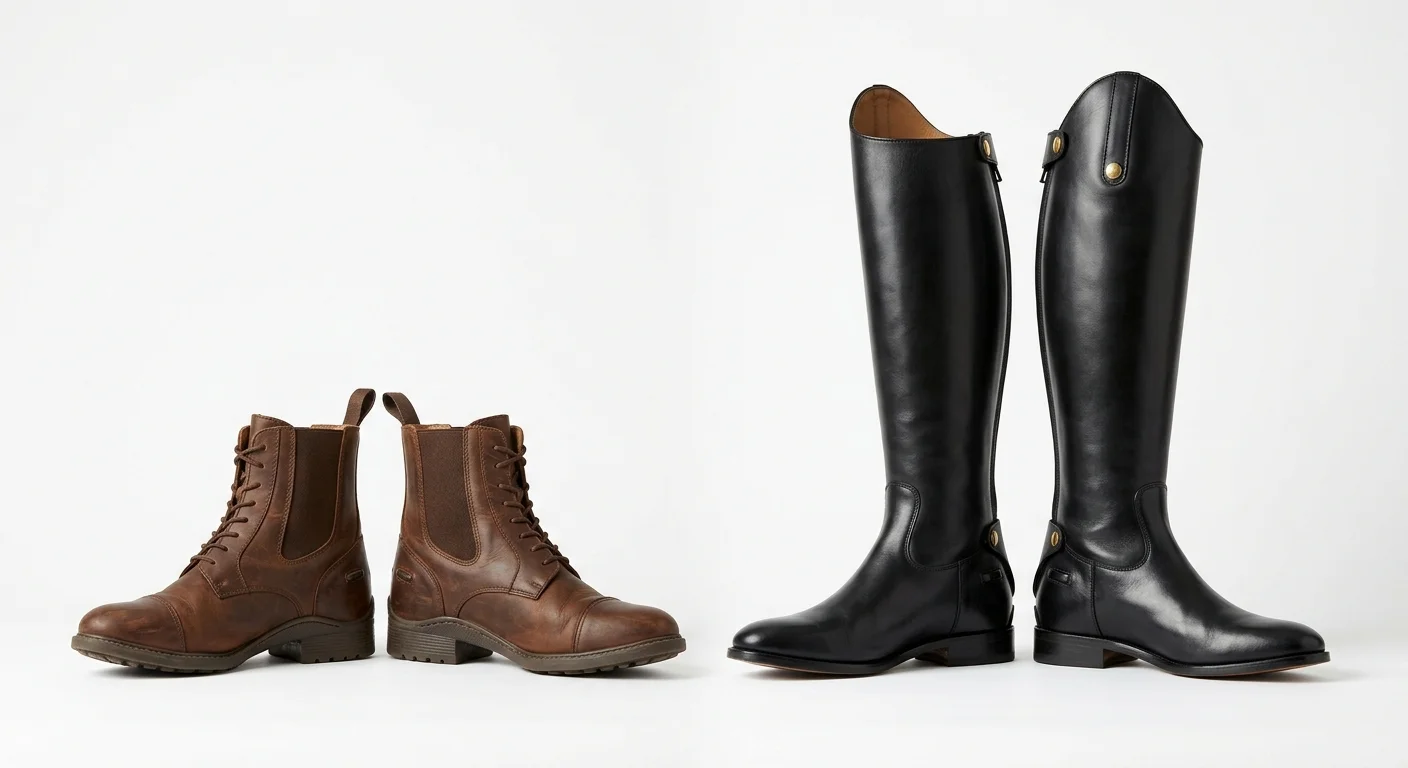
English boots are built for feel. The low heel — no more than an inch — keeps your foot level and responsive in the stirrup. The snug shaft wraps your calf tight, sending subtle leg aids straight to the horse. The sole flexes. That flex is entirely intentional. In dressage or jumping, you want to sense the ground, not be cut off from it. If you're investing in premium custom equestrian apparel, your boots certainly need to reflect that same level of close-contact engineering.
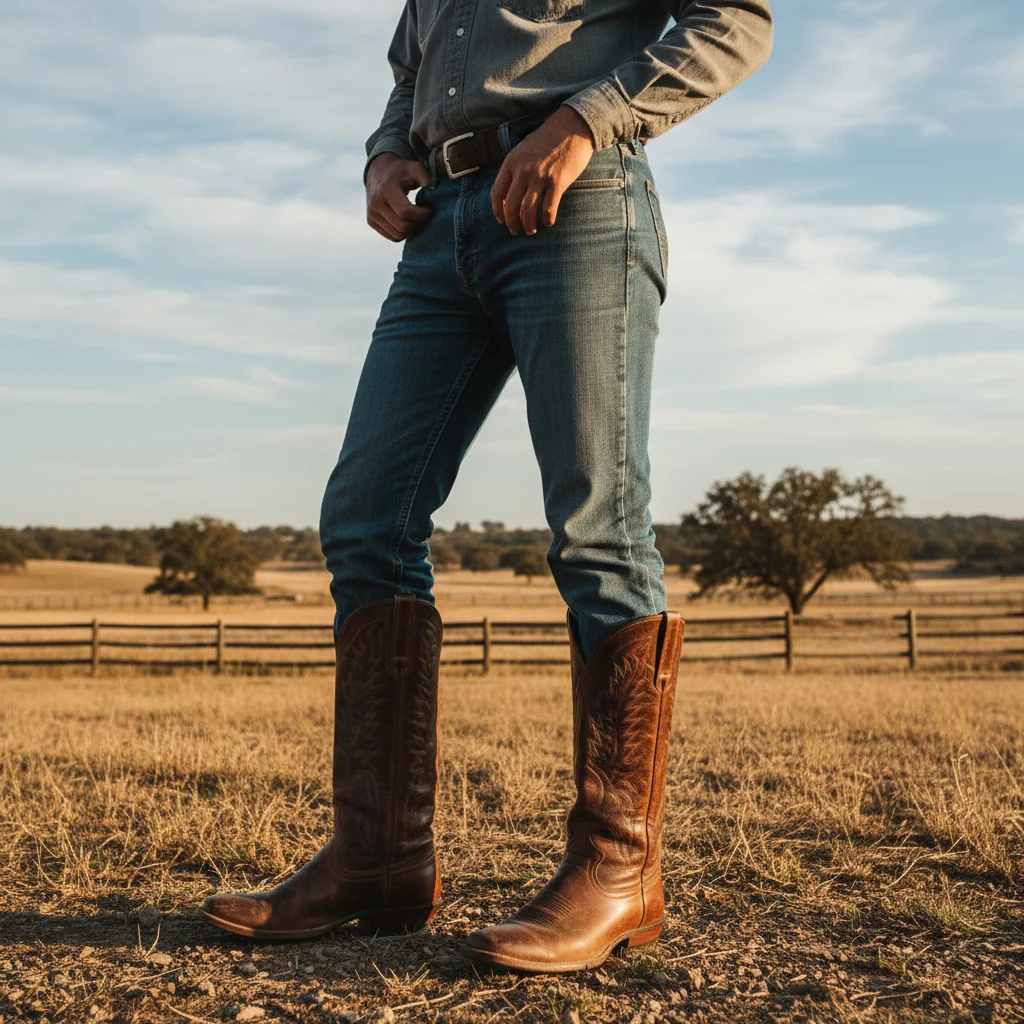
Western boots are built for grip and release. The taller heel, sitting at 1 to 1.5 inches, locks into a deep Western stirrup and holds firm. The pointed toe makes mounting fast — slide in, go. But that smooth, stiffer sole? It releases clean if you get thrown. That critically reduces entrapment risk during fast-paced ranch work.
English Riding Boots: Design, Types, and When to Use Them
English riding boots are built around one essential idea: quiet communication. Every design decision — the snug calf fit, the smooth sole, the precise heel height — works to keep noise out of your leg aids and keep clarity exactly where it belongs.
The design logic behind the boot: The heel sits at one inch. Not for aesthetics, but because that inch is a strict safety standard. It's the minimum needed to stop your foot from sliding right through the stirrup iron. The sole is smooth, or close to it. Flat treads grip the stirrup edge beautifully, whereas chunky ones catch and trap. These aren't style choices; they're the baseline every safe riding boot has to meet.
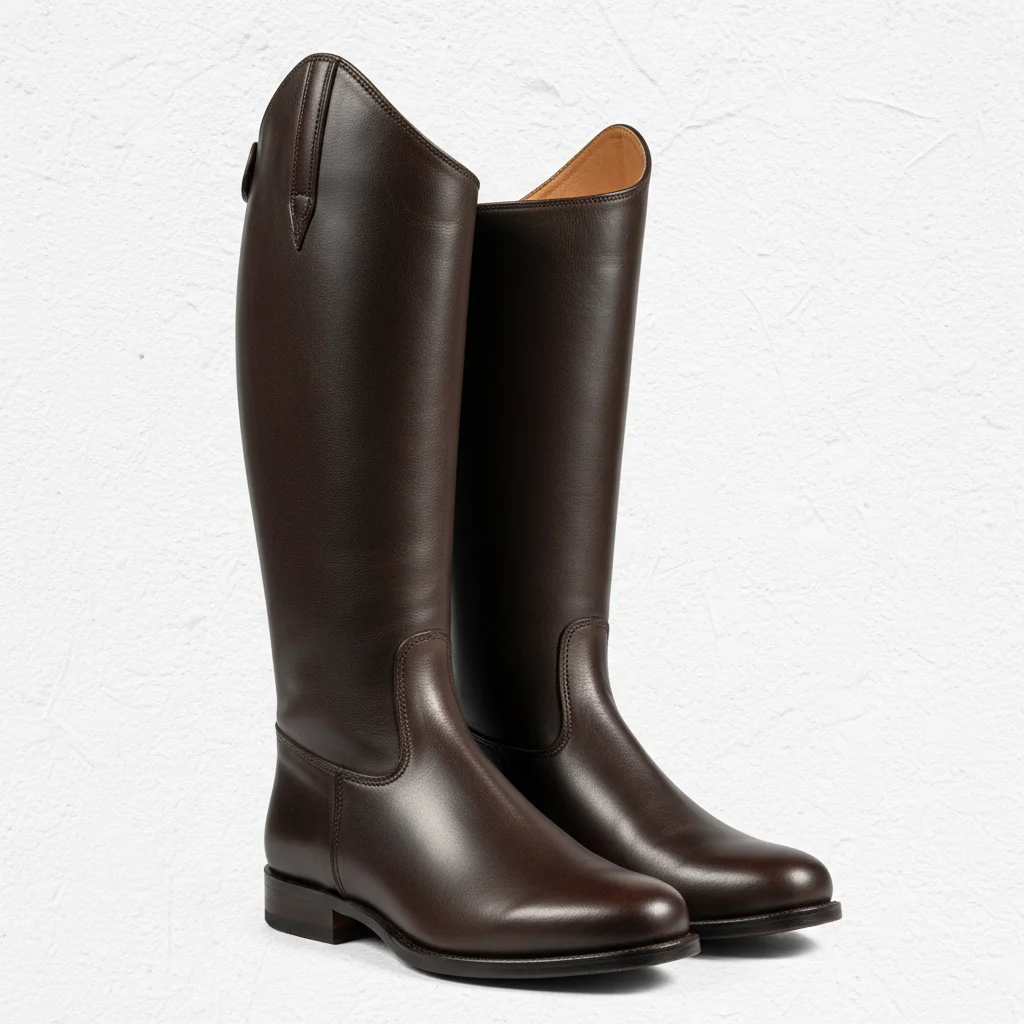
The shaft tells a very similar story. Tall boots rise just below the knee — reaching mid-kneecap fresh out of the box, dropping about 2 cm as the leather breaks in. That snug calf wrap isn't just about the classic silhouette. It completely strips bulk from your lower leg so your aids land clean, and your horse doesn't ever have to guess.
One practical note on sizing: measure your calf at its widest point in the afternoon, wearing your riding breeches. Add 2 cm. A boot that feels painfully tight in the store is often the right fit. It'll comfortably stretch and settle into its final custom-like shape with active wear. For a detailed guide on this process, see our article on how to break in new riding boots.
Four types, four different jobs: Field boots are the true workhorse of English riding. The giveaway is the lacing at the ankle. That lace, combined with soft leather that creases specifically with use, effortlessly supports the ankle flexibility a jumping position needs. Hunter/jumper riders, eventers, everyday schooling — field boots handle absolutely all of it.
Dress boots wisely drop the lacing for a flat, impeccably polished front panel. They look much cleaner at formal hunter classes. Some dressage riders have picked them up over the years, though that honestly wasn't their original intent.
Dressage boots are a rigid category on their own. Stiffer overall construction, a striking higher Spanish topline, a robust full-length zipper. They purposely don't crease at the ankle — that's the whole point. Dressage riding continuously calls for a flat foot and long, sustained leg contact rather than ankle mobility. In this case, the stiffness is the main feature.
Paddock boots sit right at ankle height. They're undeniably practical and remain the go-to starting point for most enthusiastic beginners. On their own, they won't cut it at formal upper-level competitions. But pair them with half chaps, and you get something functionally close to a tall boot — at a mere fraction of the price.
Matching boot to discipline:
Discipline | Boot Type | Why |
|---|---|---|
Dressage | Dressage boots | Stiff shaft enforces flat foot position |
Show jumping | Field boots | Ankle flex for two-point position |
Eventing | Field boots | Flexibility across jumping phases |
Formal hunter classes | Dress boots | Polished, laceless appearance required |
Daily schooling | Paddock boots + half chaps | Cost-effective and practical |
Tall boots are mandatory at most formal English competitions. Paddock boots alone definitely won't meet the judge's standard. At lower-level casual schooling shows, the paddock boot and half chap combo is admittedly sometimes accepted — but you should always verify the rulebook before you pack your show kit.
Western Riding Boots: Design, Types, and When to Use Them
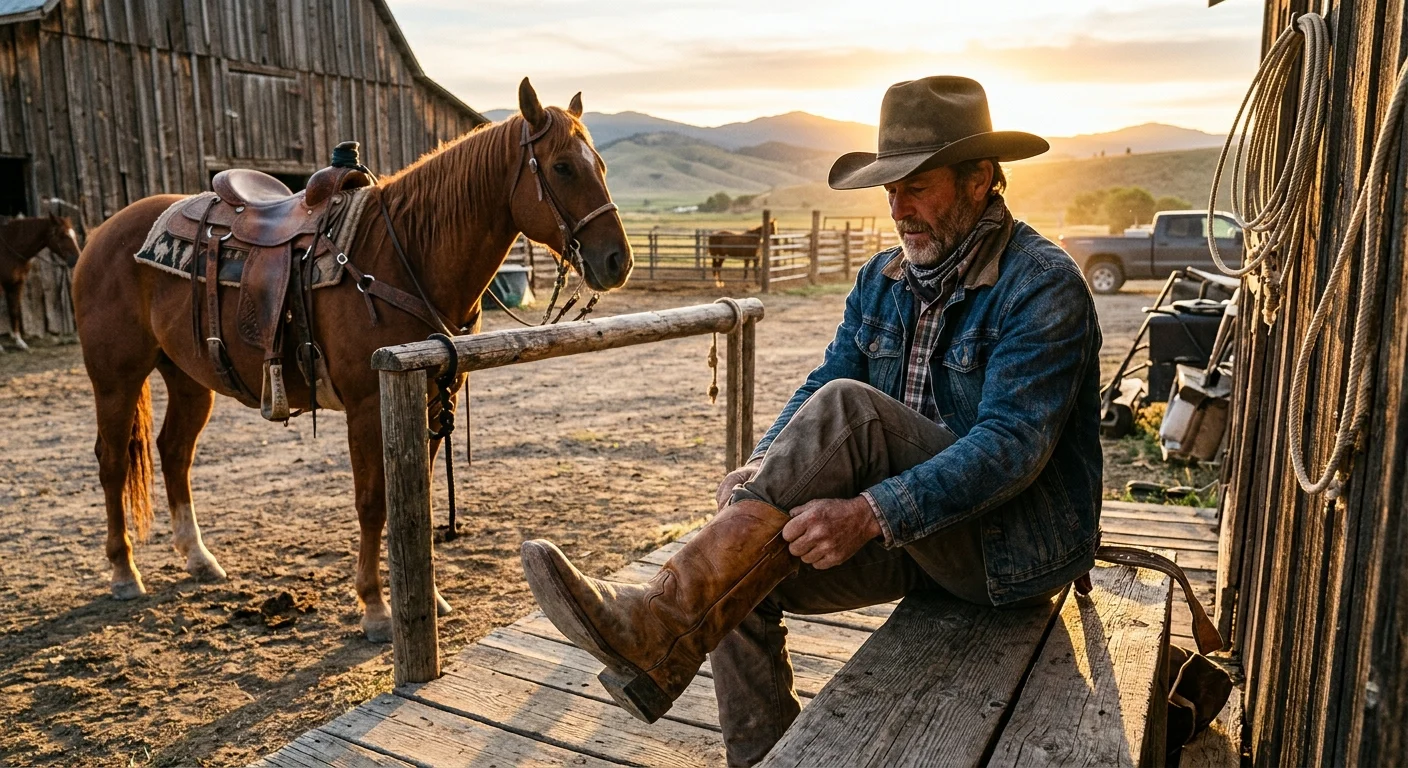
Western boots were honestly never designed in a corporate boardroom. Raw necessity boldly shaped them. A cowboy fundamentally needed his foot to stay solidly put at a fast lope — and critically release clean if the horse tragically went down. That rich, working history currently lives in every specific measurement.
The design logic behind the boot: The angled heel prominently sits at 1.5 to 2 inches, largely depending on the style. It performs exactly one crucial job: hook tightly behind the stirrup tread and hold on. The classic pointed or low-profile toe smoothly slides in fast. The smooth leather sole securely grips the stirrup edge without dangerously snagging. Absolutely none of this is decorative. Every single part intelligently works with the rest. Pull one piece out and the whole system starts to break.
Shaft height often varies far more than most new buyers expect. Traditional cowboy boots confidently run 11 to 12 inches. Purpose-built western riding boots actually stretch to 12 or 13 inches for noticeably greater calf coverage. Interestingly, an experienced equestrian clothing manufacturer will expertly design riding denim specifically to break perfectly over these much taller western shafts. Ropers, on the other hand, boldly sit much shorter — about 7 to 10 inches — uniquely featuring a squared-off heel and a functional rubber traction sole. Work-western boots casually fall somewhere in between. They're totally practical and undeniably no-fuss, built heavily for a grueling full day on the ranch, not an upscale show pen.
Four types, four different jobs:
Type | Shaft Height | Heel | Sole | Best For |
|---|---|---|---|---|
Cowboy Boots | 11–12" | 1.5", angled | Smooth leather | Formal western events |
Riding Boots | 12–13" | 2", angled | Smooth leather | Trail and discipline riding |
Ropers | 7–10" | <1.5", squared | Rubber tread | Daily use, casual rodeo |
Work-Western | 9–12" | ≤1.75" | Rubber tread | Ranch work |
Whether you're exploring reining, aggressive cutting, or fast barrel racing — cowboy boots heavily featuring a high angled heel and smooth sole are undeniably the industry standard for competitive western disciplines. Standard ranch work and casual weekend trail riding usually call for basic ropers or tough work-western styles instead. That grippy rubber traction sole won't magically earn you stylistic points in the show pen, but it definitely keeps you safely upright on wet, slippery ground. Ultimately, that's a very fair trade.
Getting the fit absolutely right: Western boots genuinely fit unlike almost any other mainstream footwear you've casually worn. You should typically start by accurately measuring from your heel to your longest toe. Subtract roughly 0.2 inches for standard pencil thickness. Next, carefully measure the widest literal point at the ball of your foot. A typical men's medium width (D) runs about 4.0 to 4.2 inches. A women's standard medium (B) sits cleanly at 3.2 to 3.4 inches. For context, a US men's size 9 equally measures 10.25 inches in total length.
You should always double-check the specific brand's own sizing chart. Major labels casually run a bit differently from one another. That tiny sizing gap painfully adds up over an especially long trail ride.
General price nicely lines up with the intended type:
Head-to-Head Comparison: 6 Key Differences Between English and Western Boots
Here's what seriously matters.
1. Heel Height: English boots conservatively heel at 0.5 to 1 inch. Western boots intentionally run distinctly higher — 1 to 1.5 inches. That mere half-inch vertical gap is doing immense real-world work. It purposefully anchors your foot firmly against the notably deeper tread of a standard Western stirrup. If you incorrectly put an English heel directly into a Western stirrup, your foot alarmingly floats. If you shove a Western heel awkwardly into an English iron, your leg incorrectly shifts entirely too far back. Trust me, your trainer will absolutely notice long before you casually do.
2. Toe Shape: Traditional English boots are generally rounded. Classic Western boots elegantly taper to a distinct point. This clearly isn't just about flashy looks — it's primarily about raw speed. The narrowly pointed toe easily finds the wooden stirrup without you ever needing to nervously glance down. In fast cattle work or highly-paced Western disciplines, that tiny split second really adds up.
3. Sole Flexibility: Standard English soles beautifully flex through the entire forefoot. On the flip side, Western soles are remarkably smoother and surprisingly stiffer. Both intentional choices are perfectly on purpose.
English riders fiercely need reliable ground feel. The subtle feedback channeled directly through the flexible sole is exactly how your delicate leg aid precisely reaches the moving horse. Conversely, Western riders frantically need a fast, clean exit. A notably smooth, incredibly stiff sole safely slips free directly from the stirrup exceptionally fast — absolutely no snagging if you happen to fall. One specific sole is meticulously built for subtle communication. The other is practically built for uncompromised safety.
4. Shaft Fit: Sleek English shafts closely wrap the rider's calf extremely tight. Traditional Western shafts naturally leave a lot more breathing room. The famously snug English fit intentionally cuts out practically all the fabric bulk that would dangerously dull your subtle leg aids. Meanwhile, manufacturers crafting premium private label equestrian clothing know that the looser Western fit brilliantly works with considerably thicker rugged ranch clothing, holding up wonderfully through an intense full day of backbreaking hard work.
5. Boot Height and Style Options: Typical English riding largely gives you just two main viable options: elegant tall boots or perfectly practical short paddock boots. Standard paddock boots stylishly pair with matching half chaps for basic competition. Rugged Western riding boldly covers far more visual ground — featuring high-heeled flashy show boots right for the public pen, and much shorter-heeled solid ropers suitable for grueling everyday work. The outward style predictably matches the demanding job.
6. Stirrup Compatibility: Without a doubt, this heavily matters the most for your personal safety.
English boots are highly engineered exclusively for narrow English stirrup irons. Conversely, Western boots are precisely built strictly for the much deeper, significantly wider Western stirrup. If you recklessly swap them, you instantly break the crucial mechanical fit that safely holds your fragile foot firmly in place — and brilliantly releases it cleanly if you tragically go down. Fascinatingly, both classic styles primarily use tough full-grain leather sitting at 2–3mm structural thickness, prominently featuring smartly double-stitched heavy stress points. The base materials are honestly close to entirely equal. However, the exact fit and overall geometry are absolutely not.
Feature | English | Western |
|---|---|---|
Heel Height | 0.5–1 inch | 1–1.5 inches |
Toe Shape | Rounded | Pointed |
Sole | Flexible, light tread | Smooth, stiff |
Shaft Fit | Snug calf | Relaxed |
Height Options | Tall boot or paddock boot | Show boot or roper |
Stirrup Match | English irons | Deep Western stirrups |
Can You Use Western Boots for English Riding (or Vice Versa)?
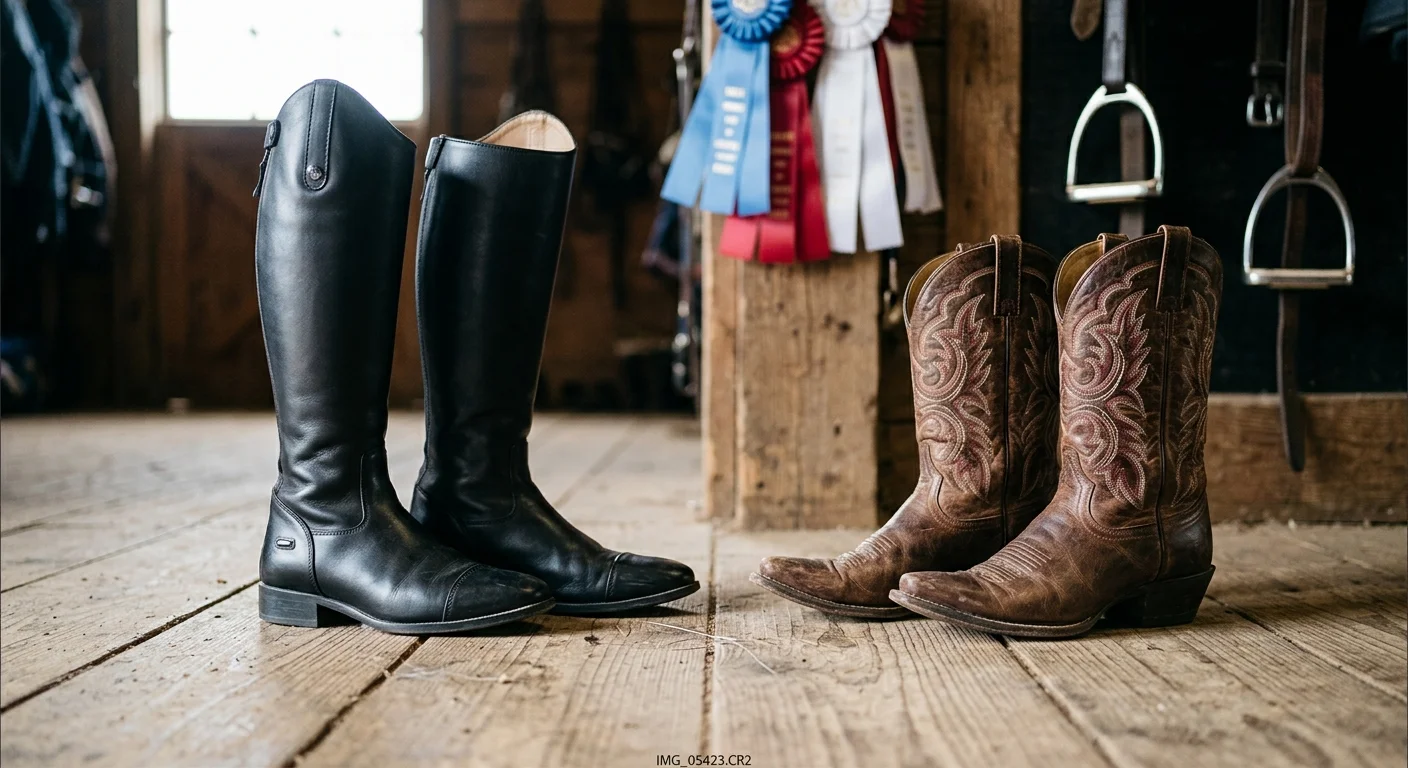
Yes — but honestly, it's a remarkably bad idea. The specific reasons are far more critically specific than you'd probably expect.
The core unavoidable problem is physical geometry. Western boots naturally have a steep 1.5-inch angled heel and a dramatically tapered toe. Conversely, English stirrup irons are notoriously narrow. If you stubbornly put those two incompatible elements together, you instantly get a very real entrapment safety risk. Your constrained foot silently slides entirely too far deeply into the iron stirrup. A sudden unexpected fall gets drastically much harder to safely escape. If you oddly flip it around, the inherent danger unfortunately doesn't magically go away — it just abruptly shifts. An English boot's notably low, softly rounded heel quickly slips straight dangerously through a gaping wide Western stirrup. Out alone on a rough trail at high speed, that's legitimately a serious imminent problem, certainly not a minor aesthetic one.
At competition level, there's no wiggle room. Western boots are strictly non-compliant across English disciplines — including dressage, structured show jumping, and demanding eventing. Casual English boots are occasionally graciously allowed at very casual Western local events, but they absolutely won't ever give you the necessary heel depth or firm stirrup stability you desperately need.
If you genuinely aren't completely sure which exact discipline you'll intimately stick with? I highly recommend you casually start with a flexible paddock boot. It features a safe low heel, a nice rounded toe, and is conveniently lace-free. Realistically, they won't seamlessly be cosmetically perfect for naturally either style, but they certainly won't recklessly put you at elevated risk in either one. Once you finally happily settle on a chosen discipline, intelligently get the specific boot heavily built for that exact rugged job.
How to Choose the Right Riding Boot for Your Discipline
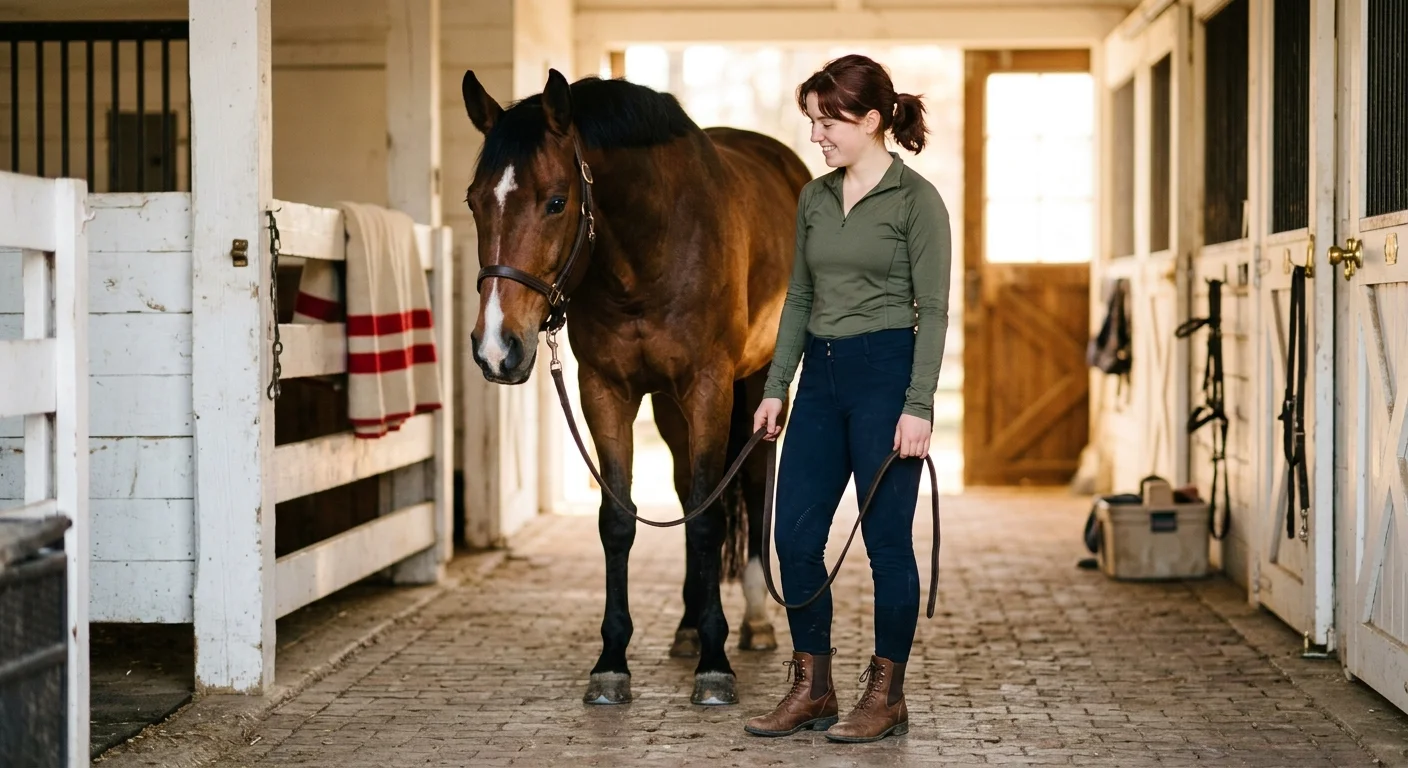
At the end of the day, your chosen discipline makes almost most of the final decision easily for you. The small remaining rest largely comes strictly down to precisely how often you regularly ride and whether you actively plan to publicly show. This rings especially true whether you're just a passionate individual rider outfitting yourself, or an up-and-coming apparel brand exploring robust OEM/ODM services to expertly build out your own competitive riding wear line.
Let's smartly start right there. Powerfully ask yourself these three critical questions, strictly in this exact order:
What discipline are you riding?
How often are you in the saddle?
Are you competing — or planning to?
Are you ambitiously riding sophisticated dressage at any remotely serious level? Stiff dressage boots are undeniably the only right answer. They boast a rigid stiff shaft, an elegant high Spanish topline, and zero lacing. In fact, USEF strictly requires simple plain black boots from competitive Level 2 visibly upward. Importantly, that's a hard rule, definitely not a casual styling suggestion.
Aggressive jumping invariably means selecting flexible field boots. The uniquely laced ankle purposely exists for an excellent functional reason. You desperately need that dynamic flex as your heavy heel sharply drops and your hip dynamically opens high over a massive fence. Conversely, a rigid, stiff dressage boot frustratingly works strongly against you entirely through every single demanding stride of a complex jump course.
Are you actively competing in testing eventing? Classic tall boots are strictly required seamlessly across all three grueling phases. There are practically zero exceptions. Fortunately, there are generally no strict color restrictions.
Are you totally new to horseback riding or just casually schooling quietly at home? Basic paddock boots smartly paired with snug half chaps are undoubtedly the most practical, logical choice. They wonderfully cost significantly less, easily go on much faster, and reliably hold up perfectly fine for intense daily schooling sessions. You just really need to logically know they absolutely won't visually cut it at upper-level formal shows.
The smartest long-term setup: Honestly, keep sturdy paddock boots strictly for your tough everyday dirty work, and carefully save pristine tall boots exclusively for the pristine show ring. Your expensive show boots smartly stay vastly cleaner, dramatically last much longer, and consistently look incredibly sharp precisely when it visually counts the most.
FAQ: Common Questions About English vs Western Riding Boots
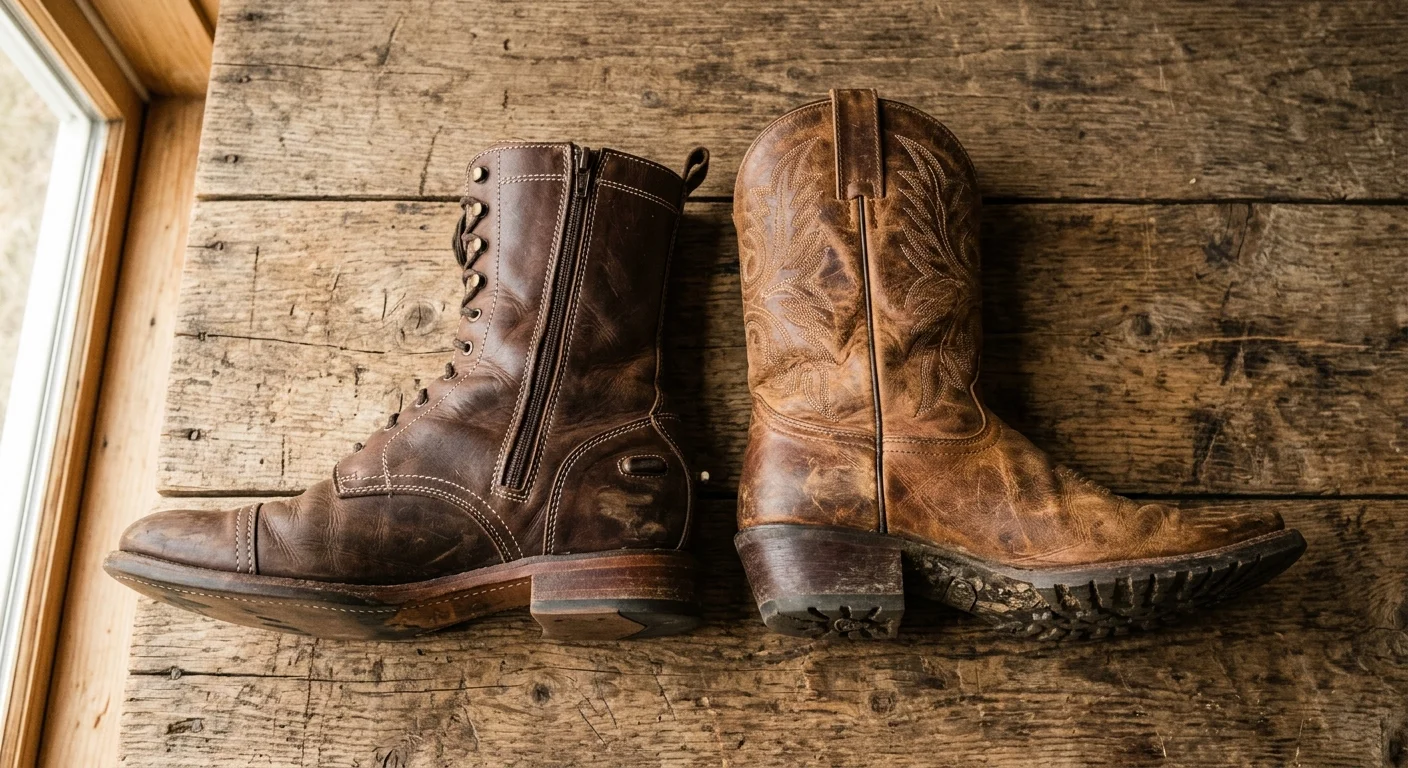
Countless new riders frequently ask almost the exact same questions. Here are the dependably straight, honest answers.
Are cowboy boots truly safe for active horseback riding?
Yes, absolutely — and the functional design transparently tells you precisely why. The prominent 1.5-inch steep heel securely stops your active foot from dangerously sliding straight through the deep stirrup. The sleek pointed toe effortlessly gets you securely in incredibly fast. The noticeably smooth stiff sole safely releases perfectly clean if you happen to unfortunately fall. Standard ropers intentionally run a noticeably lower heel, usually around 1 practical inch. That perfectly suits rapid calf roping and extremely quick ground dismounts. For long trail riding, grueling ranch work, or intense cattle events, classic cowboy boots flawlessly do the precise job they were meticulously originally built for.
Do beginners realistically desperately need expensive tall boots primarily for early English riding?
Not at all, especially at first. You should smartly start out with simple paddock boots ideally paired tightly with snug half chaps.
The upfront cost is vastly lower. They're undeniably so much easier to casually put on. Furthermore, they dependably hold up perfectly fine for basic daily dusty schooling. Formal tall boots realistically only become strictly necessary right at the competitive show ring. However, at that advanced point, they're definitively not merely optional.
Can classic Western boots ever practically work acceptably for English riding, or perhaps the other way completely around?
In highly speculative theory, maybe yes. In harsh daily practice, a resounding no. The noticeably differing heel heights simply don't safely practically match the differing stirrup geometry. That blatant mismatch unavoidably creates very real physical instability — unfortunately not just an awkward stylistic look. For extremely casual everyday unmounted barn life and brief casual riding outings, basic Western boots can arguably move slowly between casual settings decently well enough. But delicate English boots frankly don't. They're remarkably meticulously built exclusively for the English saddle and quite literally not much else.
Video Guide
Conclusion
A Note on Sourcing Quality Gear: Finding the perfect boot is realistically only half the active battle; the remaining rest largely comes strictly down to what you thoughtfully wear while in the saddle. For growing businesses, riding schools, and emerging brands actively looking to consistently supply passionate riders with the absolute very best, seamlessly partnering with a premier equestrian clothing factory like RunEquestrian completely changes essentially everything. They are a highly dedicated, deeply experienced equestrian clothing manufacturer dependably providing top-tier, reliable OEM/ODM services for diverse apparel labels located functionally worldwide.
Whether your unique brand desperately needs an entirely custom equestrian outfit meticulously designed boldly right from scratch, or perhaps you're finally scaling rapidly up with premium wholesale equestrian clothing, their skilled professional team comfortably handles all of it. Genuinely creating durable high-end custom equestrian clothing requires an intense, deeply authentic understanding of the sport’s very precise physical demands. As arguably one of the most impressively reliable equestrian outfit manufacturers widely operating in the competitive industry today, RunEquestrian actively leads the complicated way among elite custom equestrian apparel creators. In the often complex B2B textile market, they brilliantly make successfully launching beautiful private label equestrian clothing remarkably smooth and incredibly professional, functionally taking all the frustrating guesswork completely out of the complex production timeline. Partnering reliably with such dedicated equestrian manufacturers effortlessly ensures that your dedicated riders will continuously look absolutely as remarkably sharp and technically polished as the premium durable boots they proudly ride in.
Ready to finally boldly shop? Browse our extensive full educational guide to premier equestrian footwear. Because frankly, your sturdy reliable boots should always comfortably be the absolute last stressful thing on your worried mind once you're finally happily settled securely in the saddle — definitely not the very first annoying thing you're nervously questioning.